
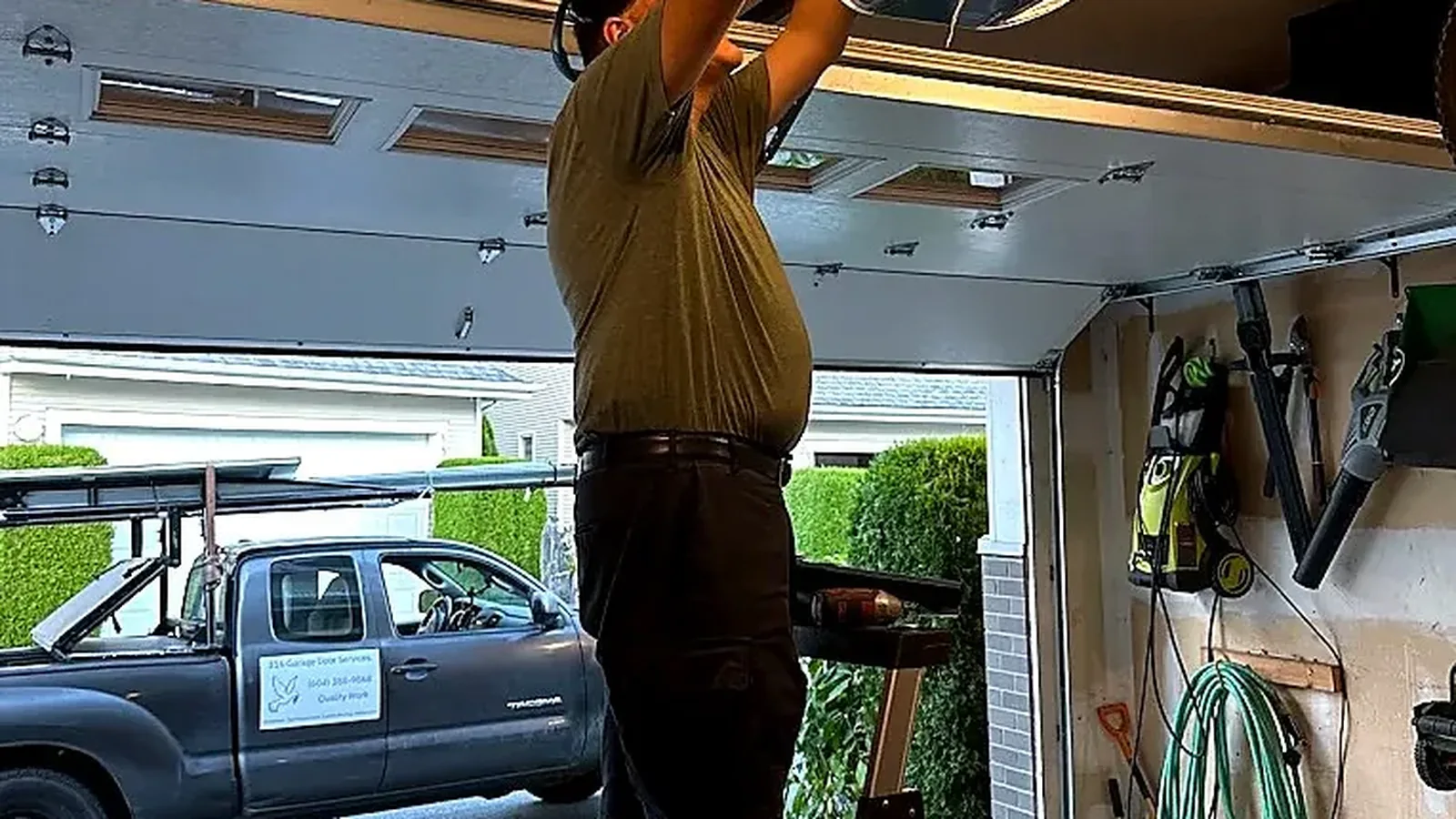
A single-car garage door is typically a three to five hour job. A double runs four to six, and adding an opener is another one to two hours on top. The old door comes out first, the opening is checked and prepared, then tracks, panels, springs and hardware go in, followed by the opener, seals and testing. Rotted jambs, low headroom and awkward access are what push it longer.
How long does garage door installation take?
Those are typical times for a straight replacement on an opening that turns out to be sound. They are trade estimates, not a promise. Nobody can give you a finish time before the old door is off and the framing is visible, and anyone who does is guessing.
| Job | Typical time on site |
|---|---|
| Single-car door, door only | 3 to 5 hours |
| Double-car door, door only | 4 to 6 hours |
| New opener added to the same visit | 1 to 2 hours more |
| Framing repair found mid-job | Work pauses until you approve the extra |
Two things stretch those numbers more than anything else: an opening that is not square, and a door that arrives in the wrong size. The first is common in older Langley and Surrey homes. The second is rare, and it is why the crew measures the opening before anything comes down.
What should I clear before the crew arrives?
- Empty the garage floor under and beside the door, including anything leaning on the tracks.
- Move the cars off the driveway so the crew can work and park a truck.
- Clear a path to a power outlet — most installs need power for tools and the opener.
- Secure pets indoors, away from the opening.
- Tell us about anything unusual in advance: low headroom, a finished ceiling, a storage rack over the door, or a door that has been hit.
One more thing worth doing: take a photo of the inside of the garage before the crew starts. If a track gets bumped or a wall gets scuffed, you both have a reference point instead of a memory.
Hour one: arrival, measure and removing the old door
The crew confirms the opening measurements and that the door on the truck matches the order. Then the old door comes down.
This is the one genuinely dangerous stage, and the reason a door removal is not a DIY task. The springs carry the door's weight and have to be wound off in a controlled way before anything is unbolted. The door then comes apart panel by panel, the tracks come down, and the old hardware is bagged and taken away.
If you are watching, stay out of the opening and out of the fall zone. There is no useful reason to stand under a door that is being de-tensioned.
Hour two: preparing the opening
With the opening bare, the crew checks what the old door was hiding:
- Rotted or split jambs, especially at the bottom corners where water sits.
- Out-of-square openings, which are common on older homes and change how the tracks are set.
- Headroom — whether a standard rail opener fits, or whether this is a wall-mount job.
- Header condition for the opener bracket and the torsion bar.
Most of the time this is quick. Occasionally it turns into carpentry, and that is better found now than halfway through. If it does, the work pauses and you get a call with the extra cost before anything continues.
This is also where a decision gets made that homeowners rarely see: whether the existing opener can stay. A modern opener rated for the new door's weight often can. A door that is heavier than the one it replaced, or an opener near the end of its life, is the usual reason it makes sense to change both at once — the power and the ceiling access are already sorted.
Hour three: tracks, panels and springs
Vertical tracks are set plumb and anchored, then the horizontal tracks and the curved transition between them. Panels go in from the bottom up, with hinges and rollers fitted as each one lands. The torsion bar, springs and drums go above the door, and the springs are wound to the tension the door's weight requires.
Then the door is run by hand. It should lift easily and stay where you put it. If it does not, the spring tension or the track is wrong, and that gets corrected before the opener is touched.
On a double door, or a door with glazed sections, this is the stage that runs past its hour. Panels are heavy, and a window section has to sit level or the whole door looks wrong from the street.
Hour four: opener, seals and testing
If there is a new opener, the rail goes up, the head unit is anchored to solid structure rather than drywall, and the wall control and safety sensors are wired. The photo-eyes are mounted parallel to the floor and no more than 15 cm (6 in) above it, which is the height DASMA's installation guidance specifies, then aligned until both LEDs are solid.
The bottom seal goes on late, because it has to sit on the slab rather than hover above it. Then the part that matters most. Travel limits are set so the door closes onto the floor and compresses the seal evenly without crushing it. Force is set to the manufacturer's specification, not turned up until the door finally shuts. The safety reverse is tested with a 38 mm (1.5 in) obstruction flat on the floor, and the door has to reverse on contact within two seconds.
The remotes, keypad and myQ app are paired last, and the door is cycled several times in both directions.
Why that test is not a formality
A residential opener has to provide two separate layers of entrapment protection: something built into the operator, plus a second device at the opening — in practice the photo-eye pair. In the US that is 16 CFR Part 1211, which adopts UL 325 and requires a closing door to reverse within two seconds of hitting an obstruction.
Openers sold in Canada are built to ANSI/CAN/UL 325, the binational version of the same standard, so the behaviour is identical here. The gap between a door that passes that test and one that fails it is usually ten minutes of adjustment, not a part.
What happens at handover
The old door and debris leave on the truck, and the crew walks you through the door, the opener and the remotes. Pay attention now, because it is the only time someone who knows this specific door is standing in your garage.
Run this list before they drive away:
| Check | What good looks like |
|---|---|
| The door sits flat | The bottom seal compresses evenly across the whole opening. No gap at one end, no daylight under the door. |
| Safety reverse works | Lay a 2x4 flat under the door and close it. The door reverses on contact instead of pressing down on the wood. |
| Both photo-eyes are solid | Two steady LEDs, lenses roughly 15 cm (6 in) off the floor and facing each other squarely. |
| Travel is quiet and even | No scraping, no hesitation, no bang at either end of the run. |
| You can operate it | Wall control, each remote, the keypad and myQ all work, and you know where the red release handle is. |
Ask for the manual and the model numbers of the door and the opener while the crew is still there. You will want both the first time something needs a part.
One last thing: a new door is not silent, and it should not be. Hinges and rollers bed in over the first few weeks. If a noise appears that was not there on day one, what each garage door noise means tells you whether it is settling or worth a call.
What can make installation day run longer?
- Rotted framing that needs repair before tracks can be anchored.
- Low headroom requiring low-headroom track or a wall-mount opener.
- A finished or obstructed ceiling that makes the opener mount slow.
- No power near the opener, requiring an outlet or a longer run.
- Weather — rain and wind slow exterior work and make the opening hard to protect. Cold affects the sealant more than the door, and a frozen slab makes it hard to set the bottom seal cleanly (what to do when a garage door freezes shut).
None of these are unusual. That is the honest reason a quote based on photos is an estimate until the old door is off, and it is not a sales tactic.
What drives the cost of a garage door installation?
Four things move the number: door size, insulation and glazing, the opener and hardware package, and whatever the opening needs once it is bare. A single uninsulated steel door and a double insulated door with windows are not close in price, and no honest quote pretends otherwise.
Our Langley cost guide breaks down what each of those adds. If you are still deciding whether a new door is warranted at all, repair versus replace is the more useful read first. If you are choosing an opener at the same time, the opener guide covers belt, chain, screw and wall-mount without the sales pitch.
After the install, the door needs very little: a monthly safety-reverse test and a yearly look at the rollers, hinges and seal. Our maintenance checklist lists the whole routine with timings.
Where we install in the Lower Mainland
We install new doors and openers across Langley, Surrey, Coquitlam and the rest of Metro Vancouver and the Fraser Valley. Residential work runs 9am to 6pm, Monday to Saturday, and there are no travel fees in that area.
For a realistic time and price before the day, call 604-388-9868 or send photos of the opening and the inside of the garage. Two photos — one from the driveway, one from inside looking out — tell us more than a paragraph of description. If you are still comparing products, the residential installation service page covers door types, insulation values and what we fit as standard.
Sources and standards
- 16 CFR Part 1211 — Safety Standard for Automatic Residential Garage Door Operators (entrapment protection, two-second reversal, manual release requirements)
- DASMA Technical Data Sheet 382 — photoelectric sensor installation height (parallel to the floor, no more than 15 cm / 6 in)