
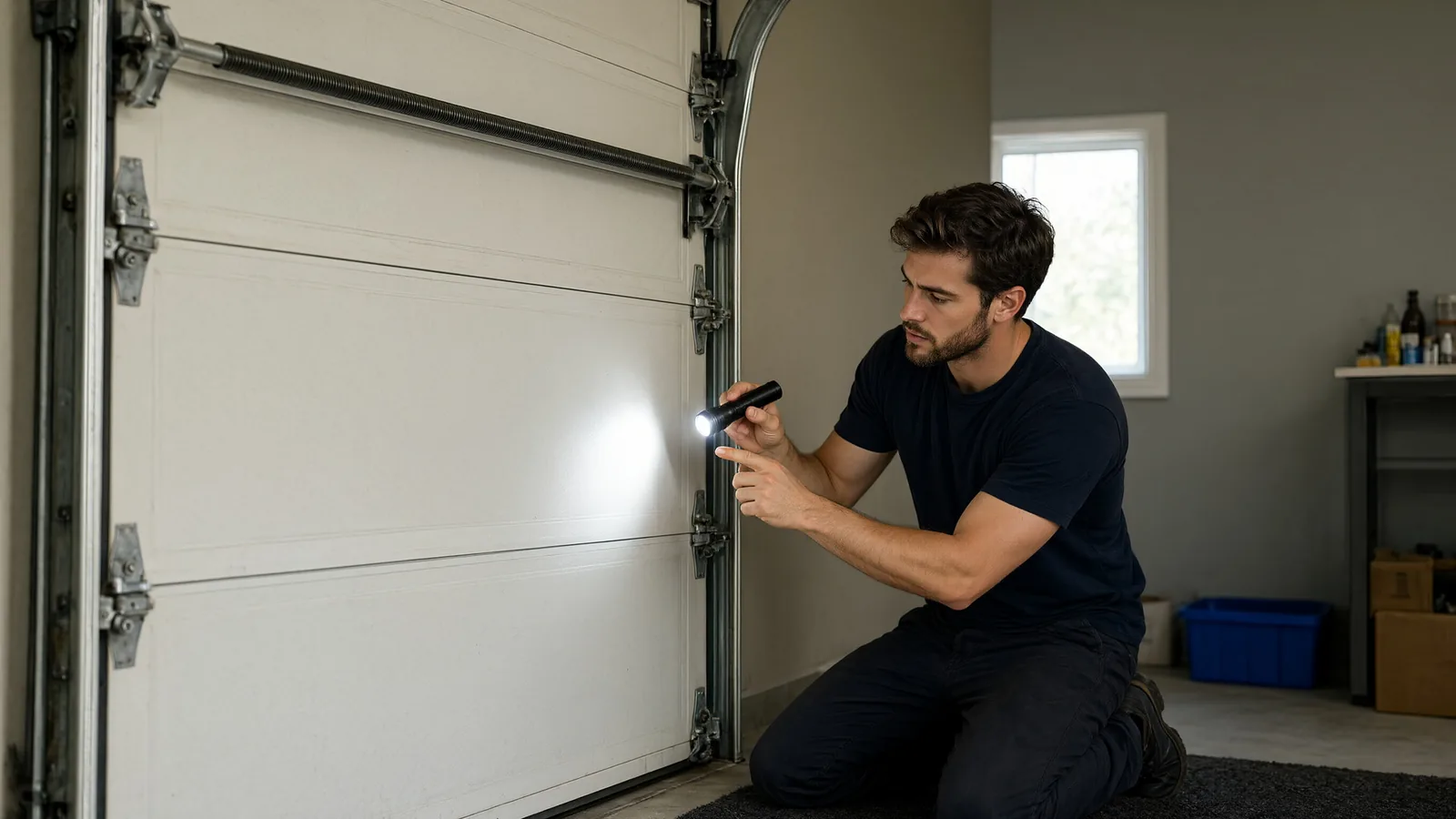
A garage door is off track when one or more rollers have left the channel that guides them. Stop using the opener at that point. The motor keeps pushing a door that can no longer travel straight, and that is how a cheap re-seat becomes a bent track, a snapped cable or a door that drops.
The direction it failed in is the tell. If it came off while closing, look at the bottom of the vertical track: an impact, grit or gravel in the channel, a roller that has gone flat. If it came off while opening and nothing touched it, the track is usually the victim rather than the cause.
A broken garage door spring on a two-spring door, or a cable that has jumped its drum, leaves one side doing more of the lifting, and the door racks in the opening on the way up. That version gets misdiagnosed, because the track is the part that looks bent.
First, three things not to do
- Do not run the opener again. Not to "see if it resets", not to close it for the night. The operator cannot steer a jumped roller back into the channel; it can only add force to a door that is already out of line.
- Do not lift one side by hand. A door stuck at an angle is being held by one cable while the other hangs slack. Forcing one corner up transfers that load onto the cable, the drum and the track edge on the other side.
- Do not pull the red release and walk away. Releasing the trolley on a door that is out of balance can let it drop hard. If you have to release it, do it with the door fully closed and your body clear of the opening.
If one side is hanging, or a cable looks slack or frayed, keep people and vehicles out of the opening until someone qualified has looked at it.
What "garage door off track" actually means
A sectional door hangs on rollers fixed to the edge of every panel. Those rollers run inside a vertical track on each side, which curves into a horizontal track that carries the door overhead. The vertical track guides the door; the horizontal track carries its weight once it is up.
When a roller leaves the channel on one side, three things happen together. That side loses its guide. The rollers still in the track take a load they were never set up for. And the panel edge starts dragging on the steel instead of rolling inside it — which is the scraping noise most people notice first. A single garage door roller off track on one side is the usual version, and the cheapest one to put right.
The six reasons a garage door jumps its track
1. An impact
The cause we see most often. A bumper, a bike, a ladder, a wheelbarrow, a bin pushed against the lower track. The track bends a few millimetres, the roller no longer has a clear channel, and the next cycle pops it out. A door with a low bottom section needs very little of a hit.
2. Worn rollers
Rollers are the cheapest part on the door and they take the most punishment. A steel roller with a dry or worn bearing stops turning and starts dragging, and a dragging roller climbs the track wall instead of rolling along it. Nylon rollers run quieter, but the cheap ones flat-spot and crack, and the first cold snap finishes them. In the Lower Mainland, damp air and winter road salt speed all of that up.
3. Loose track fasteners
Tracks hang on brackets and lag screws that work loose over years of vibration. A track that has shifted a few millimetres out of plumb steers the door out of the channel a little more on every cycle. This is the quiet failure behind most "it just came off on its own" calls.
4. A cable or spring problem wearing a track costume
If a cable has jumped its drum, or one torsion spring of a pair has snapped, the door stops being lifted evenly. One corner drops, the door racks in the opening, and the track takes a side load it was not designed for. The track gets blamed and replaced; the cable that caused it gets missed. On a door that came off while opening, the cables and springs get checked before anyone touches the track.
5. Debris in the channel
Grit, leaves, gravel, a screw, a dropped hinge bolt. Anything sitting in the channel gets rolled over until the roller rides up and out over it. This is the one cause you can usually see from the floor with a flashlight.
6. A track that was straightened instead of replaced
A bent track that got straightened keeps a weak spot at the bend, and a door installed with the tracks out of plumb never ran true to begin with. Both come off again, and each visit gets billed again.
What to do in the next five minutes
- Stop the opener and, if the door is fully closed, unplug it so nobody presses a remote by accident.
- Look, do not touch. From the floor, check whether a roller is sitting outside the track, whether the track is bent or pulled off the wall, and whether either cable is slack or frayed.
- Check the obvious. A bumper resting against the track, a bin, a bike, gravel in the channel.
- Keep the opening clear if the door is hanging or part open, and keep the car out of it.
- Call. An off-track door is not a weekend project, and the longer it hangs, the more of the door it takes with it.
Garage door track repair: what the job actually involves
It's rarely just "put the roller back". A repair that lasts looks like this:
- Support the door and take the load off — springs wound off or the door braced before anything is moved.
- Re-seat or replace the rollers — every roller that is seized, flat-spotted or cracked, not only the one that came out.
- Straighten or replace the track. A light bend can sometimes be corrected. A kink, or a track that has bent twice in the same place, gets replaced, because a straightened track will keep throwing rollers.
- Check the cables and drums for fraying, slack, and correct seating on the drum.
- Re-level the door so both sides travel together, then check the gap across the floor.
- Balance it and test it — disconnected and balanced by hand, reconnected, then the safety reverse and photo-eyes tested.
The last two steps are the ones that get skipped, and skipping them is how a door ends up off track again. A door that is not balanced loads one track harder than the other on every cycle. What the job costs depends on which of those steps you need — our Langley garage door repair cost guide shows how the bill is built.
Can you fix a garage door off track yourself?
On a light single door, with one roller sitting just outside the channel and no cable or spring involved, some homeowners manage a re-seat with a pry bar and a helper. We'd rather you didn't, for two reasons. The door is unstable the moment it leaves its guide, and the parts that hurt people on a garage door — springs and cables — are the ones that fail quietly when a door goes out of line.
A bent track, a slack cable, a double door or anything more than a few centimetres out of line moves the job out of DIY territory. There's no version of this where the door is lighter than it looks.
How do you test a repaired door before you trust it?
A repair isn't finished when the door runs. It's finished when it passes the test the opener was built to. 16 CFR Part 1211 requires a closing residential door to begin reversing within 2 seconds of contact with an obstruction, and requires two layers of entrapment protection: the operator's own force sensing plus a second device, which in practice is the photo-eye pair at the bottom of the tracks. Canadian openers are built to the binational ANSI/CAN/UL 325, so the same behaviour applies here.
Two checks, a minute each. Lay a length of 2x4 flat in the opening and close the door: it must reverse on contact, not press down on the wood. Then pass your leg through the beam while the door is closing: it must reverse straight away.
Photo-eyes belong low, and six inches is the number. DASMA's six-inch rule puts them no more than 6 inches (15 cm) above the garage floor, because a beam mounted higher lets someone lying or crawling beneath it pass undetected. Technical Data Sheet 382 sets the same limit for commercial operators and adds that the sensors must sit parallel to the floor.
Preventing the next one
- Look at the tracks monthly: straight, plumb, clean, fasteners tight.
- Keep the lower track clear of bins, bikes and garden tools.
- Do not hang anything from the tracks or the door.
- Treat a new noise as a warning — grinding or scraping is a roller or alignment problem announcing itself.
- Service the door once a year, which is when loose brackets and worn rollers get caught. Our annual garage door maintenance checklist covers what to check and how often.
When to call us
- The door is hanging, crooked or part open and will not move.
- A cable is slack, frayed or off its drum.
- The track is visibly bent or pulled away from the wall.
- The door came off while opening, not closing.
- The door is a double, or wider than a single-car opening.
We are based in Langley and cover the Lower Mainland, and an off-track door is one of the calls we prioritise, because a door left hanging damages parts that were still fine. Our residential garage door repair service covers tracks, rollers, cables and springs. Call 604-388-9868 or send us a photo of the track and the roller — that photo usually tells us whether to bring a roller, a track section or a cable set.
If the door has not jumped the track but will not close, the fault is elsewhere: start with why a garage door won't close. If the track has bent twice in the same place, the question stops being about the track — repair or replace the door walks through that decision.
Sources and standards
- 16 CFR Part 1211 — entrapment protection and reversal requirements — two layers of protection, and reversal within 2 seconds of contact
- DASMA — the six-inch rule for photoelectric sensors — no higher than 6 inches (15 cm) above the garage floor
- DASMA Technical Data Sheet 382 — photoelectric sensor installation height — parallel to the floor, no higher than 6 inches (15 cm), on commercial operators