Hanging, crooked or off its track is the emergency. A door stuck fully open is a security problem. A door stuck closed is usually an inconvenience until morning. In all three cases: stop pressing the button, keep people out from under the door, and do not force it.
If it is hanging, crooked or a cable looks slack, leave it exactly where it is. If it is stuck fully open and the panels and tracks look straight, the door itself is probably sound, so secure the opening rather than forcing it closed.
1. Stop pressing the button
Whatever the symptom, the opener cannot fix a mechanical fault, and every cycle adds force to something already failing. If the door is making a new noise, hanging unevenly or moving in jerks, stop.
If the door is fully closed and safe, unplug the opener so a remote in a pocket or a car cannot start it.
2. Work out which garage door emergency you have
- Stuck open. Security risk. The priority is securing the opening, not closing the door by force.
- Stuck closed. Inconvenience, unless a car is trapped or someone needs to leave. Usually the safest of the three to leave overnight.
- Hanging, crooked or partly down. Safety risk. Keep everyone out from under it.
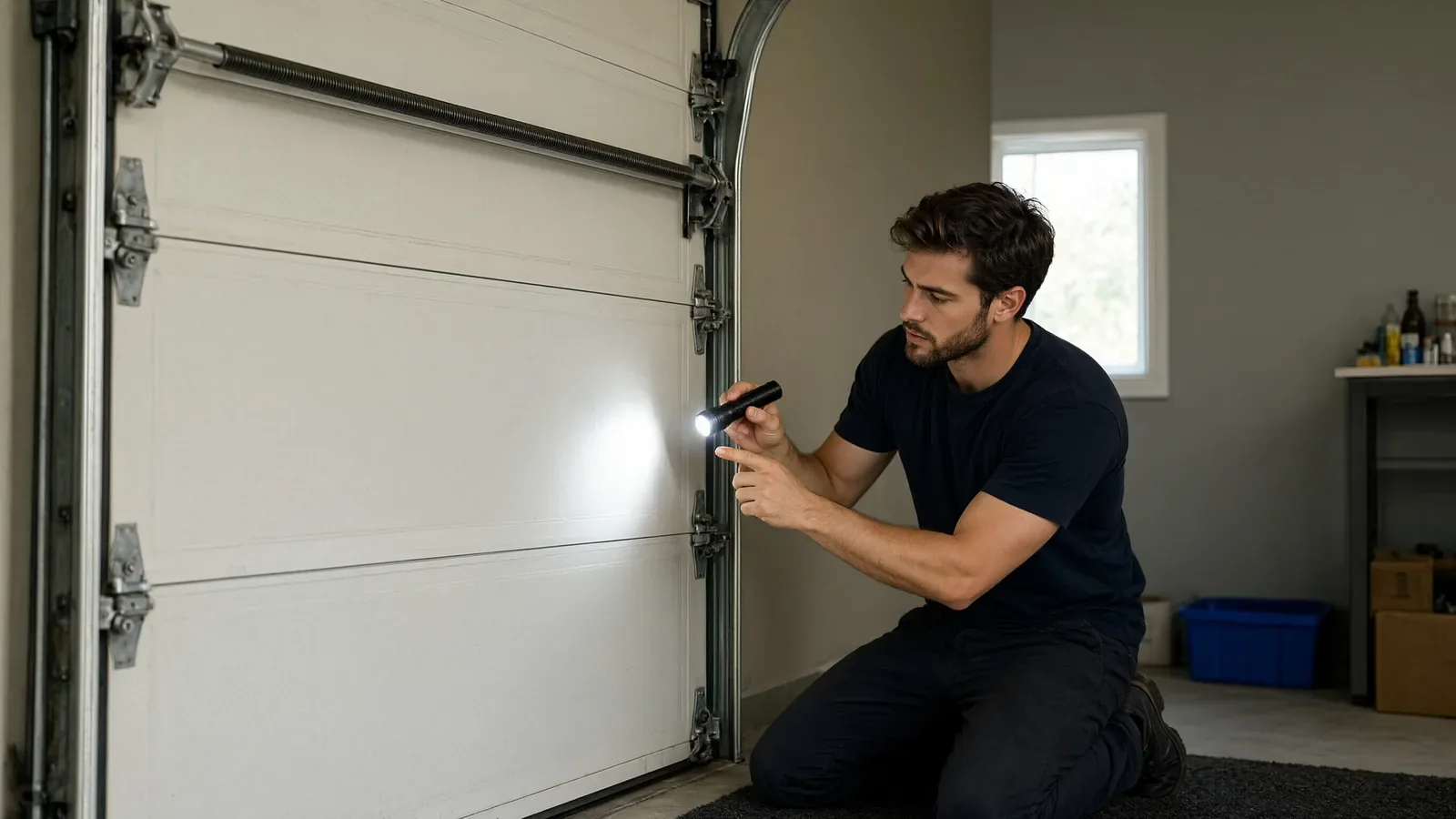
- A bang, then a door that will not lift. A torsion spring has almost certainly snapped, or a cable has let go. Do not touch either. A broken spring has a look and a sound you can check from the floor.
- Vehicle impact. Note it for insurance before anything is moved, and photograph the damage.
3. Secure it, do not force it
If the door is stuck open and the panels and tracks look straight: the fault is usually the opener, the photo-eye pair at the bottom of the tracks, or a travel limit. The door itself is sound. Lock the garage from the inside, block the opening with a vehicle if you have one, and if the door can be lowered by hand safely, do that. If it cannot, secure the house side and call.
If the door is hanging or crooked: do not try to close it. A door that has left its track can drop, and a person under it can be seriously hurt. Rope off the area, keep children and pets away, and wait for a technician. This is the one problem on the page where doing nothing is genuinely the right move.
If a car is trapped inside: the red manual release handle disconnects the door from the opener trolley so it can be lifted by hand — but only attempt that if the door feels balanced and light. On a door with a broken spring it will be far too heavy, and pulling the release will let it drop.
That handle is part of the safety standard, not a convenience: 16 CFR Part 1211 requires it to be marked and explained to the owner, and openers sold in Canada are built to the binational ANSI/CAN/UL 325.
4. Protect the opening overnight
If the door cannot be closed, the practical options are a vehicle parked across the opening, a heavy barrier inside, or moving anything valuable out of the garage. Do not wedge the door with a ladder or a bin — if it comes down on that, it will damage the panel and can kick the obstruction out at speed.
Do not disconnect the safety sensors to make the door close. A door that closes because the safety system was defeated is exactly the failure the standard exists to prevent, and it is also a liability if someone is hurt. If the door reverses before it reaches the floor, that is a sensor or limit fault worth diagnosing, not bypassing.
5. Call, and have this ready
- A photo of the whole door, and a close-up of whatever looks wrong.
- The door type (sectional, one-piece, roll-up) and roughly how wide it is.
- The opener make and model from the label on the head unit.
- What the door does when you press the button: nothing, hums, moves and stops, reverses.
- Whether the door can be left safely as it is.
That last point decides the response. A door that is safely closed can usually wait for a normal residential appointment. A door hanging over a walkway or standing open on a street cannot.
What actually counts as an emergency?
Honestly, three things:
- The door is unsafe — hanging, off track, or a spring or cable has failed while the door is open.
- The opening cannot be secured and the garage is exposed to the street.
- A business cannot operate — a commercial bay or dock door blocking deliveries or staff.
Everything else — a door that will not close on a Saturday evening, a remote that stopped working, a noisy opener — can usually wait for the next working day without getting worse. Saying so costs us callouts; it saves customers money.
Commercial service runs 24/7 across Langley and the Lower Mainland, because a stuck bay door stops a business. Residential work runs 9am to 6pm. If it is a genuine safety emergency, call anyway and describe it — we will tell you honestly what can be done tonight, and if the answer is morning, what to do in the meantime.
What not to do, ever
- Do not cut, adjust or touch springs and cables. They hold enough energy to injure or kill.
- Do not force a crooked door with the opener or by hand.
- Do not stand under a partly open door that is hanging.
- Do not disable the safety sensors to get the door closed.
- Do not let a child or pet stay in the garage while you work on it.
Afterwards
Once it is repaired, ask what caused it. A door that failed because of a worn roller, a loose track bracket or a spring at the end of its life will do it again in the same conditions. Our maintenance checklist covers the checks that catch those, and if the door is failing repeatedly, repair versus replace is the conversation worth having before the third callout.
Call 604-388-9868 or send photos and the opener model. Describing what the door does in one sentence is usually enough to know what to bring.
Sources and standards
- 16 CFR Part 1211 — entrapment protection, reversal and emergency release marking — the standard behind the red handle and the reversal test
- DASMA Technical Data Sheet 382 — photoelectric sensor installation height — on commercial operators, sensors sit parallel to the floor and no more than six inches above it