An opener cannot invent a command. It sits still until something closes the wall-control circuit or the receiver accepts a code, then it runs the motor to its limit. That is the whole device. So when the door is up and nobody touched a button, something is holding a contact closed or repeating a signal — and both leave evidence you can find.
That makes this a security problem before it is an annoyance. The garage is the largest opening in the house, and an open door at 2am is an invitation. Treat it as urgent even on the days it behaves.
Here is the short list, in the order we work through it:
- A stuck wall control. The button never releases, so the opener keeps seeing a press.
- A shorted control wire. A staple, a rodent or water joins the two conductors. Electrically identical to a button press.
- A remote that is still paired. The previous owner's, a spare loose in a drawer, or an old fixed-code unit that can be replayed.
- Automation. A myQ schedule, a geofence, or a smart-home routine doing exactly what it was told.
- A failing logic board. Usually after a surge, and usually with other symptoms attached.
Start here: is the wall control stuck?
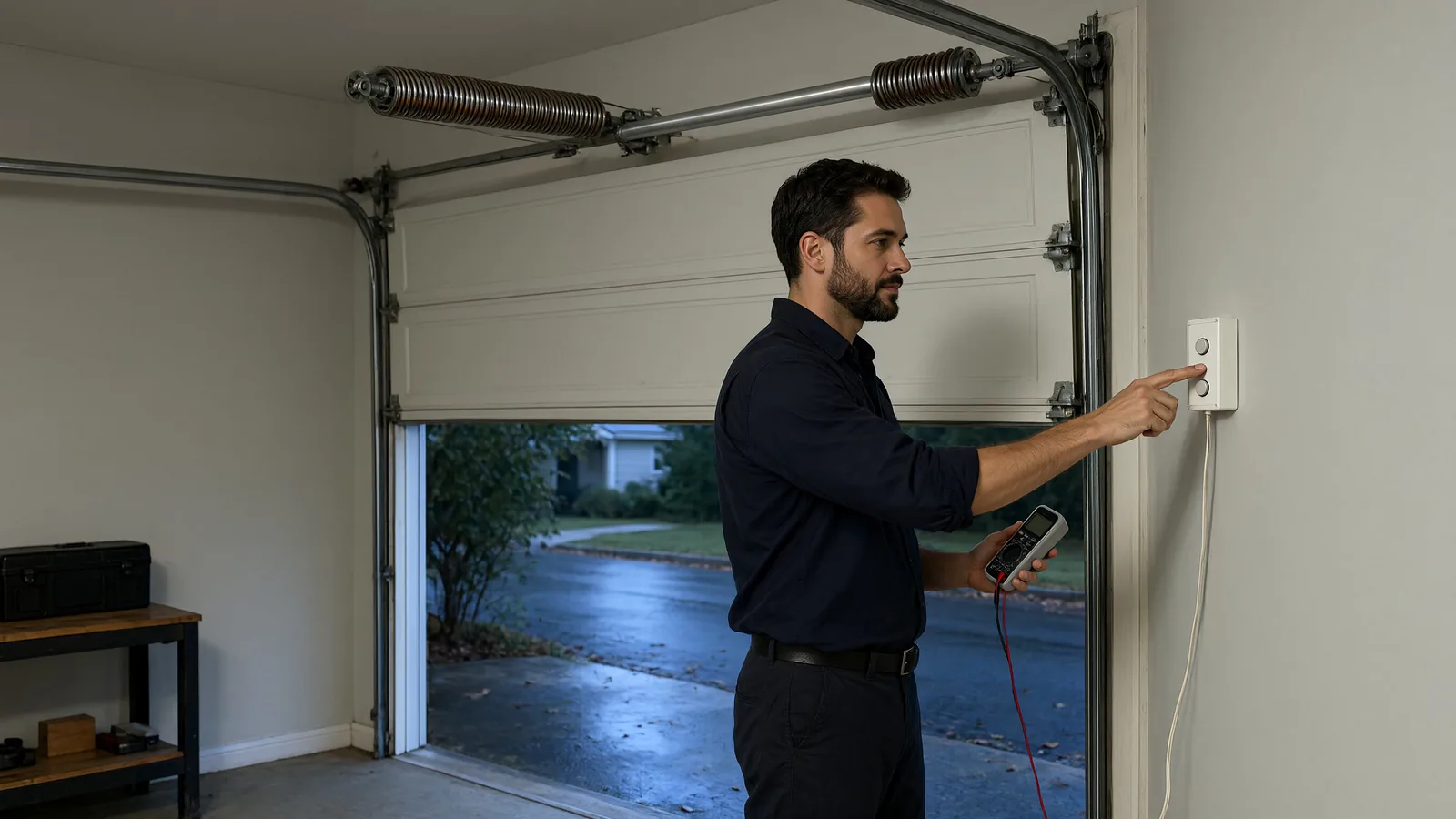
The wall station inside the garage is where we start, because it is wired straight into the opener and it fails in a way that looks exactly like a ghost.
Inside the station is a momentary push button, the same kind of switch as a doorbell. It is meant to close the contact only while your finger is on it. Push it hard, catch it with a bike handlebar, paint over the faceplate, or let damp air work on the contacts, and it can stay closed.
The opener then sees a button that never lets go. The door runs up, and on many models the stuck contact re-triggers the opener when its timer resets. That is why the door opens again ten minutes after you shut it.
Test it in three steps. Unplug the opener. Disconnect the two low-voltage wires at the opener head, not at the wall. Plug the opener back in and leave it for a few hours — overnight if your door opens at night.
If the door stays shut with the control out of the circuit, the fault is in the station or its wire. If it still opens, the wall control is innocent. Move on.
One trap worth knowing: the lock or vacation button on a wall console is a separate circuit. It blocks remotes. It does nothing about a stuck button. So if your remotes have gone dead but the wall button still runs the door, check that lock button before anything else.
What else makes a garage door open by itself?
Six more causes, again in the order we find them. The first three are wiring and radio, the next two are software and hardware, and the last one is a rare mechanical fault.
1. A shorted or damaged control wire
The wire from the wall control to the opener head is thin, low voltage, and often stapled to a stud in a hurry. A staple driven through the insulation, a rodent, a shelf bracket or water tracking down the wall can join the two conductors. A short across those wires is electrically identical to someone holding the button down, and the opener cannot tell the difference.
Wet weather makes it worse. In Langley and across the Lower Mainland, a door that only misbehaves from October to March points here first. Look for wire pinched behind a shelf, chewed insulation near the floor, or green corrosion at the station terminals. One staple through the jacket is enough.
2. A remote that is still paired
Two versions of this, and the boring one is more common. A remote in a bag, a gym locker, a glovebox or a drawer with its button pressed against something will open the door every time the bag moves. Take every remote out of the house and the cars for a day and see what stops.
The other version is an opener holding remotes in its memory that you do not know about: the previous owner's, a contractor's, a neighbour's from before you moved in. Every opener stores paired remotes until you clear it. Hold the learn button until the LED goes out, or use your model's erase procedure, then pair only the remotes you actually hold.
Replay belongs to a specific generation. Fixed-code remotes broadcast the same code on every press, and those codes can be captured and reused. If the remote has a row of tiny DIP switches inside, it is fixed code, full stop. Current LiftMaster and Chamberlain openers use rolling codes — Security+ 2.0 on today's models — where the code changes with every press, so a neighbour's remote cannot match yours.
3. Radio interference on the opener's frequency
Openers listen on a narrow slice of radio spectrum, and a garage is a noisy place: LED shop lights with cheap drivers, wireless doorbells, baby monitors, solar inverters, and in a townhouse row, a dozen other openers inside a hundred feet.
Interference alone rarely opens a rolling-code door. Where it does show up is on older fixed-code receivers, which will accept a signal that matches, and on a receiver that is already marginal because of a failing board or a weak battery in the remote. That is also why a door that opens only when the shop lights come on is worth taking seriously.
Test it: switch off the garage lighting circuit and any smart plugs for a day. Swap the LED bulbs for a different brand. It sounds far-fetched until it is the answer.
4. Smart automation doing exactly what it was told
myQ and similar systems run schedules, geofence rules and integrations, and they inherit whatever the last person set up. A 7am schedule from the previous owner, a geofence that fires when your phone leaves the neighbourhood, or a routine on a smart hub will open the door on purpose. From the kitchen it looks like the door has a mind of its own.
Open the app and check three things: the schedule list, the geofence radius, and every linked integration. Then open the activity log. It timestamps each open and usually names whether the command came from the app, a remote or the wall control, which makes it the fastest diagnostic you own.
One hardware detail matters here. myQ connects on the 2.4 GHz band only, so a new router or a mesh system that hides that band can drop the opener offline and leave the log empty. A door that opened while myQ was offline was not opened by the app. The command came from a physical control, a paired remote, or a schedule running somewhere else.
5. A logic board that took a surge
The board is the opener's brain, and it is the part that turns a power event into a permanent fault. A lightning strike nearby, a utility surge, or a corroded solder joint can leave it firing the motor at random. Boards rarely fail cleanly. Expect random openings, lights that stay on, remotes that stop working, or an opener that runs for a second and quits.
The test is subtraction. If the door still opens with the wall control disconnected and every remote off the property, the board is the leading suspect. That is a technician diagnosis rather than a homeowner one, because the board sits inside a 120-volt housing.
6. Travel limit or travel module faults
Rare, and almost never on its own. Travel faults usually show up as a door that stops short, reverses off the floor, or loses its position after a power cut. If a ghost opening arrives alongside any of those, treat it as two faults and expect the travel module or a limit switch rather than a setting.
How do you narrow it down in five minutes?
- Read the app log first, if you have one. It usually names the source of the command.
- Unplug the opener for 30 seconds and plug it back in. A board that misbehaves straight after a power cycle is telling you something.
- Disconnect the wall control wire at the opener head and leave it off for a few hours.
- Remove every remote from the house and the vehicles.
- Write down the times. Same time daily is automation. Opens when it rains is a wire. Random, day and night, is a board or a remote.
Work the list in that order and you will usually land on the cause by step three. What you should not do is solve it by removing the safety sensors or leaving the opener unplugged as a permanent fix. A disconnected opener is a door you cannot run in an emergency, and a defeated sensor is a door that will close on a child.
Is a self-opening door dangerous?
Yes, in two different ways, and they are separate problems. Entrapment is the obvious one: a door that moves when nobody expects it can catch a child, a pet or a bike. Security is the quieter one. An open garage is the biggest opening in the building, and most garages connect to the house through a door nobody locks.
The safety rules exist because of the first risk. In the US, a residential operator built for sale on or after 1 January 1993 has to carry two layers of entrapment protection: inherent force sensing plus a second device, in practice the photo-eye pair at the floor. A closing door must also reverse within two seconds of touching something. That is 16 CFR Part 1211, which adopts UL 325. Canadian openers are built to ANSI/CAN/UL 325, the binational version, so the behaviour here matches.
None of that protects you if the board is the thing that failed. A board that fires the motor unprompted is a board you cannot trust to sense an obstruction either, which is why we treat random openings as a safety call and not an annoyance.
Until it is repaired, use the lock or vacation mode if your opener has one, keep the door latched, and unplug the opener overnight if the openings happen at night. Do not leave it unplugged for good. You lose the safety reverse, and every trip out of the garage becomes a manual release.
When should you call a technician?
- The door opens with the wall control disconnected and every remote off the property.
- The opener clicks, buzzes, or runs for a second and stops.
- The door opened on its own and now also stops closing properly.
- You have a 1990s opener and cannot clear its memory of old remotes.
- It is a commercial door, a gate, or anything wider than 8 feet.
We diagnose the cause instead of swapping parts until the door behaves. Most of these jobs end with a wall control, a length of wire, a receiver or an opener, and we tell you which before any work starts. Our residential repair service covers all of it, and the Langley cost guide breaks down labour and parts.
If the door has also stopped closing, that is a different fault with a different order of checks — start with why a garage door won't close. If the remotes are the part that quit, the triage in remote, keypad and myQ troubleshooting gets you further, faster. And if the board has already failed twice, repair or replace is the honest question to ask next.
Once it is sorted, the annual maintenance checklist is what stops the next surprise. For commercial overhead doors, our commercial repair guide covers the differences — those operators run far more cycles and fail in different places.
Call 604-388-9868 or send us the details, including the times the door opened and whether the app logged anything. That is usually enough for us to arrive with the right part on the van.
Sources and standards
- 16 CFR Part 1211 — Safety Standard for Automatic Residential Garage Door Operators — entrapment protection and the two-second reversal requirement
- UL Standards & Engagement — automatic garage door standards — how the two layers of entrapment protection work